

According to the National Association of Realtors’ 2024 Profile of Home Buyers and Sellers, 88% of recent buyers used a real estate agent – yet fewer than 40% of agents report consistently delivering a formal buyer presentation at the first meeting. That gap is costing agents clients.
A buyer presentation is a structured, agent-led meeting document and visual aid that introduces you to a prospective buyer client, outlines the home-buying process, communicates your value proposition, and – since the NAR settlement took effect in August 2024 – sets the foundation for a written buyer representation agreement.
Done right, it builds trust, sets expectations, and dramatically increases the likelihood a buyer commits to working with you. Done poorly – or skipped entirely – it leaves buyers wondering why they should choose you over the next agent.
This guide walks you through exactly how to build and deliver a buyer presentation that wins – including a 7-step structure, scripts, a buyer-type personalisation framework, objection handling for representation agreements, and a free checklist.
Key Takeaways: A strong buyer presentation defines who you are, proves your value with evidence, explains the buying process clearly, shows sample properties, and introduces a buyer representation agreement – all in 20–30 minutes.
🏡 Free Buyer Consultation Checklist
Guide your buyers with confidence. Use this checklist to prepare, qualify, and set clear expectations from the start.
Why Buyer Presentations Matter More Than Ever in 2026
The real estate industry shifted fundamentally in August 2024. The NAR settlement from the Sitzer-Burnett class action lawsuit changed how buyer agent compensation is communicated and agreed upon. Many MLSs now require agents to have a written buyer representation agreement before showing homes – and even where it is not yet mandated, best practice has clearly moved in that direction.
This makes your buyer presentation the single most important first-impression document in your business. Here is what the research tells us:
- 88% of home buyers used a real estate agent or broker in 2024 (NAR Profile of Home Buyers & Sellers, 2024)
- Buyers who attended a formal buyer consultation were significantly more likely to sign a representation agreement at or after the meeting
- Agents who deliver digital presentations report higher buyer engagement and faster decision-making than those using printed materials (Highnote internal data, 2025)
- The average buyer interviews 1–2 agents before choosing – your presentation is your competitive differentiator
What Is a Buyer Presentation?
A buyer presentation is a structured meeting tool – typically a slide deck, digital proposal, or interactive document – that a real estate agent uses during a first meeting with a prospective buyer client. It covers the agent’s background and credentials, their value proposition, an overview of the home-buying process, sample properties within the buyer’s criteria, and a sample buyer representation agreement.
A buyer presentation is different from a listing presentation, which is used to win seller clients. It is also distinct from a comparative market analysis (CMA), which focuses on property pricing. The buyer presentation is about you and your process – not a specific property.
Berkshire Hathaway HS Drysdale Properties is a strong model.
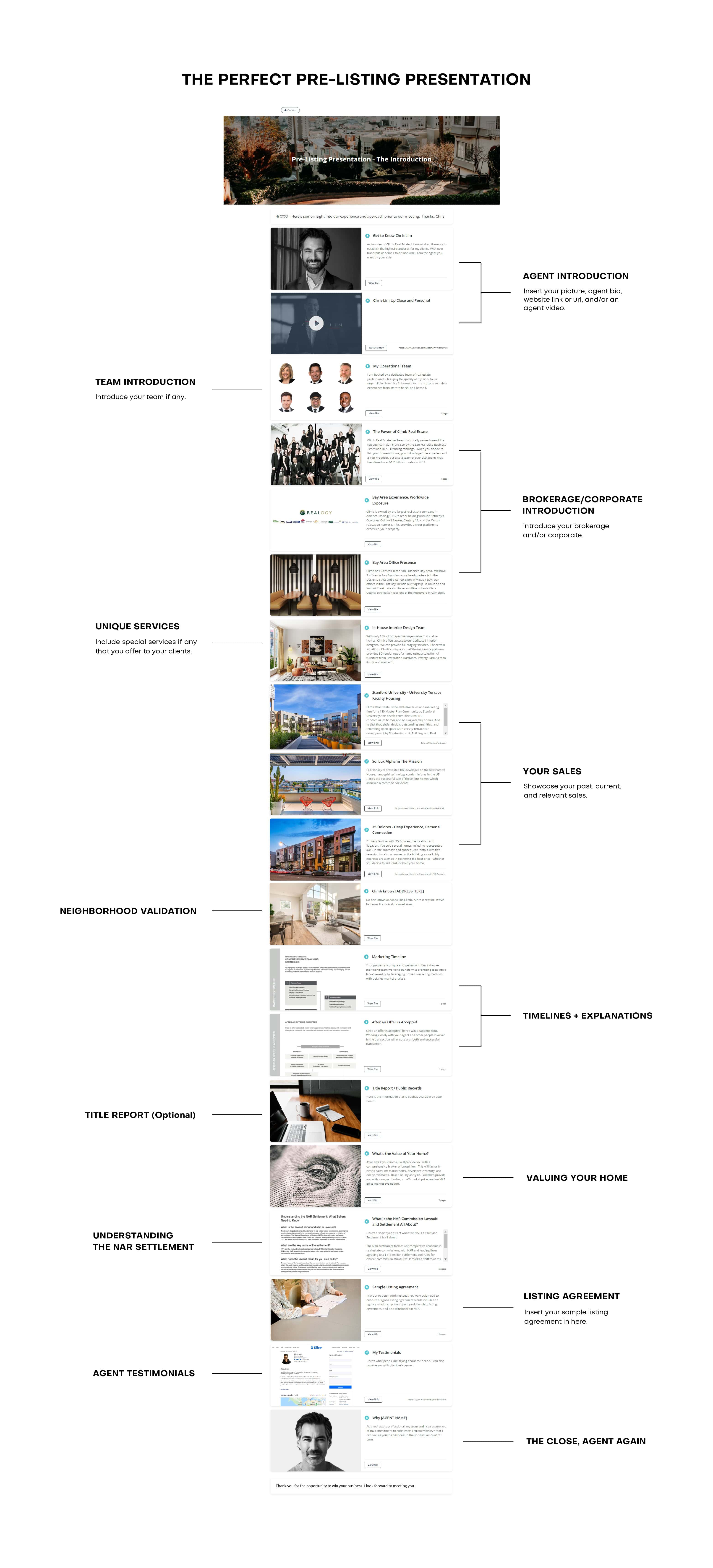
What to Include in a Buyer Presentation: Core Elements
Section | What to Include |
|---|---|
1. Introduction | Your photo, name, brokerage logo, years of experience, production stats, community involvement |
2. Value Proposition | A 2–3 sentence statement of what you do, who you serve, and what makes you different |
3. Home-Buying Process Overview | A visual timeline: pre-approval → search → offer → inspection → closing (with typical timeframes) |
4. Your Services | What you do at each stage: property sourcing, negotiation strategy, inspection guidance, closing coordination |
5. Sample Properties | 2–3 active listings or recent sales matching the buyer’s stated criteria and budget |
6. Buyer Representation Agreement | A sample agreement with plain-language explanation of key terms; do not ask for signature in first meeting |
7. Testimonials | 2–3 client reviews, ideally from similar buyer profiles (first-time, investor, etc.) |
Optional: Market Data | Local market snapshot – median price, days on market, list-to-sale ratio for target area |
P.S. We’ve created The Complete Guide to Building Winning Buyer and Listing Presentations to help agents create presentations that prove their value and win over listings and buyers!
Download it, and start winning those clients!
Let your buyer know the ins and outs of the process, how your team works, and if they should expect to work with other people down the road.
7 Steps: How to Create Your Buyer Presentation
Follow these seven steps to build a presentation that earns trust, communicates value, and moves buyers toward committing to work with you.
Step 1: Build Your Introduction Slide
Your introduction slide should answer the question buyers are silently asking: ‘Who are you, and why should I trust you with one of the largest financial decisions of my life?’
Include: a professional headshot, your name and title, your brokerage and any team affiliation, years in real estate, and 2–3 concrete production statistics (number of buyers represented, average days to close, client satisfaction score).
If you are newer to real estate, use your brokerage’s stats alongside your personal background and professional history.
Pro tip from Mark Choey, CEO of Highnote: 'I always advise agents to include something personal on their intro slide - a community involvement, a hobby, or a family photo. Buyers are choosing a person, not just a credential set. Relatability closes the trust gap faster than any statistic.'
Mark Choey
Step 2: Articulate Your Value Proposition
A value proposition is a single, clear statement that explains: what you do, who you help, and what makes you different. It should be written in plain language – no jargon – and it should speak directly to what your ideal buyer cares about most.
Value proposition framework:
'I help [target buyer type] find and secure [type of property] in [market area] by [key differentiator], so they [primary buyer outcome].'
Example:
'I help first-time buyers in the Denver metro find their ideal home within their budget by combining hyper-local market knowledge with a proactive search strategy - so they stop losing bidding wars and start closing confidently.'

Back up your value proposition with 2–3 proof points: a client testimonial, a notable negotiation win, or a statistic from your business (e.g., ‘94% of my buyer clients close within their original budget’).
Step 3: Walk Through the Home-Buying Process
Most buyers – especially first-timers – underestimate the complexity and timeline of purchasing a home. Walking them through the process step by step does three things: it demonstrates expertise, it reduces anxiety, and it positions you as the guide they need to navigate each stage.
A standard home-buying timeline looks like this:
Stage | Typical Timeframe | What You Do for the Buyer |
|---|---|---|
Pre-approval & criteria setting | 1–2 weeks | Refer lender, set search criteria, sign buyer agreement |
Property search | 2–8 weeks | Send curated listings, schedule tours, provide area insights |
Making an offer | 1–3 days per offer | Write competitive offer, advise on terms, negotiate |
Under contract / due diligence | 2–3 weeks | Coordinate inspection, review disclosures, renegotiate if needed |
Closing | 1–2 weeks | Final walkthrough, coordinate with title and lender, attend closing |
Keep this overview to 3–5 minutes of speaking time. The goal is not to cover every detail – it is to make the buyer feel that the process is manageable and that you have done this before.
Step 4: Show Curated Sample Properties
If you already know your buyer’s budget and preferences from a pre-consultation call or intake form, include 2–3 active listings or recently sold properties that match their criteria. This personalises the presentation and serves two purposes:
- It shows you have already been working on their behalf – before they have even committed to you.
- It creates a conversation that helps you refine your understanding of what they actually want vs. what they say they want.
Present each property with: address or general area, price, key features, and one sentence on why it fits their stated criteria. Be prepared to discuss compromises – a buyer who wants a 4-bedroom home under $450,000 in a hot urban market may need to adjust either their geography or their expectations.
Step 5: Present a Sample Buyer Representation Agreement
Since the NAR settlement took effect in August 2024, buyer representation agreements have moved from best practice to near-requirement. Many MLS boards now require a signed buyer agreement before you can show a buyer a listed property. State requirements vary – check your state association for the current mandate in your market.
During the presentation, show a sample agreement and walk through four key points:
- Duration: How long the agreement covers (typically 90 days–1 year)
- Exclusivity: Whether you are the buyer’s sole agent or a non-exclusive arrangement
- Compensation: How you are paid, including the new post-settlement transparency requirements
- Termination: How either party can end the agreement early
Do not pressure buyers to sign at this meeting. The goal is transparency – buyers who understand what they are agreeing to are far more likely to sign willingly and remain committed throughout the transaction.
Script for presenting the agreement:
'I want to show you a sample of the representation agreement we work with. I am not asking you to sign anything today - I just want you to understand how the relationship works so there are no surprises. Any questions I can answer now?'
Step 6: Personalise for Your Buyer Type
A presentation built for a first-time buyer looks different from one built for a seasoned investor. Segmenting your pitch by buyer profile is one of the fastest ways to increase conversion – it signals attentiveness and expertise simultaneously.
Buyer Type | Primary Concern | What to Emphasise in Your Presentation |
|---|---|---|
First-Time Buyer | Fear of the unknown; financing confusion | Process clarity, pre-approval guidance, what to expect at each stage, emotional reassurance |
Move-Up Buyer | Timing a sale and purchase simultaneously | Bridge financing options, contingency strategy, your network with listing agents |
Real Estate Investor | ROI and off-market access | Cap rate analysis, your off-market network, experience with investment transactions, due diligence support |
Relocation Buyer | Unfamiliarity with the market | Neighbourhood deep-dives, school data, commute analysis, remote consultation capability |
Luxury Buyer | Privacy, discretion, white-glove service | Off-market listings, confidentiality, your network with luxury listing agents, bespoke service model |
Step 7: Deliver Digitally and Follow Up
| Format | Advantages | Disadvantages |
|---|---|---|
| Printed / PDF | Tangible; no tech required | Cannot be updated; no engagement tracking; feels dated to younger buyers |
| Linked digital presentation | Trackable opens/views; shareable; live updates; mobile-friendly | Requires a platform; buyers need internet access |
| In-person slide deck (screen share) | Engaging in live meetings | Not shareable post-meeting; no ongoing touchpoint |
Buyer Presentation Templates
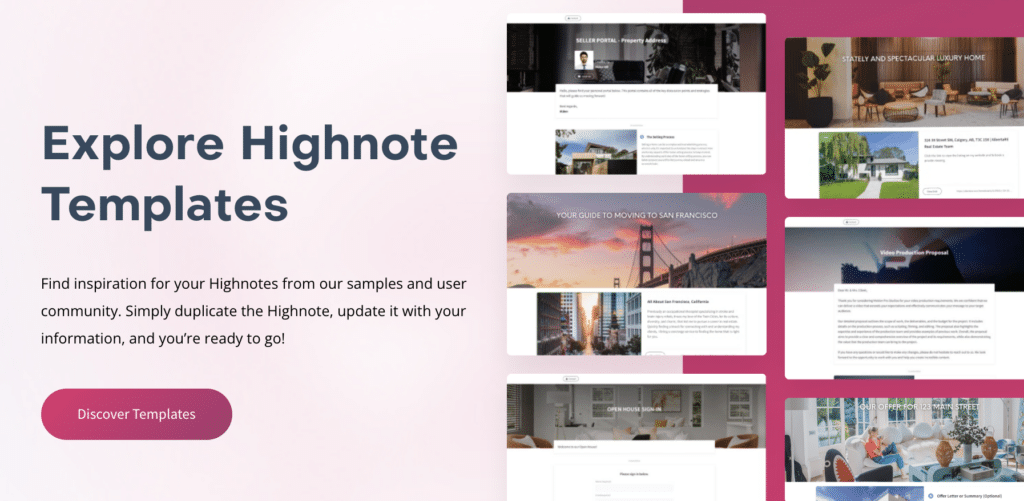
Searching for a detailed and adaptable buyer presentation template? We’ve crafted an effective template packed with all the important elements you need to easily put together your own buyer consultation presentation. These real estate presentation templates feature everything you need to get started right away: a compelling cover slide, an engaging introduction, detailed market analysis, an overview of the buyer process, insightful case study templates, a services template and even a compelling closing statement.
Highnote has made it as easy as possible to tailor and personalize your buyer template to reflect your personal branding and flair.
Real Estate Buyer Presentation Examples
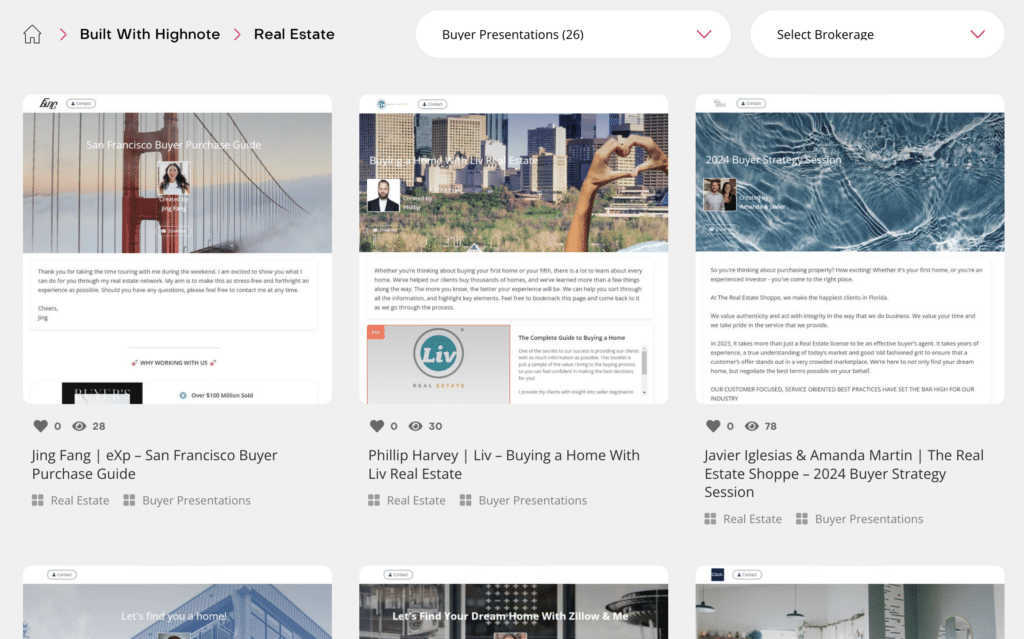
If you’re looking for ideas and inspiration on creating an effective home buyer presentation, check out successful buyer presentations built by our community. Dive into some of the finest buyer presentation examples and get inspired to create your own presentation that stands out and resonates with your buyers.
Remember to personalize your buyer presentation to 1) meet the needs of your buyers and 2) showcase what sets you apart as an agent. Using Highnote.io (and a dash of creativity), you can easily put together your own buyer presentation that elevates you above the competition and earns you more business. Check out the link below for our library of templates, or check out more real estate buyer presentation examples.
How to Handle Buyer Objections

The most common friction point in a 2026 buyer consultation is the fee. Here are the three objections agents hear most frequently – and how to respond.
Objection 1: ‘I don’t want to be locked in to one agent.’
Response: ‘That is completely understandable, and I hear that a lot. The agreement actually protects you as well as me – it sets out exactly what I am committed to doing for you and what happens if either of us wants to part ways. Most agreements include a simple release clause. I would rather work with buyers who feel confident choosing me than ones who feel trapped. Let’s talk about what concerns you most.’
Objection 2: ‘I don’t want to pay a buyer agent fee.’
Response: ‘That is a fair question given all the news around this. In most transactions, the seller still offers compensation that covers the buyer agent fee, but there are situations where that is not the case. What the agreement does is make my compensation transparent from day one – no surprises. I will always walk you through the compensation structure before we make an offer on any property.’
Objection 3: ‘I want to see a few properties before I commit.’
Response: ‘Absolutely – I want you to feel comfortable before signing anything. Let’s do this: I will take you to see [X] properties, and if you feel I am the right fit for you after that, we formalise the relationship. Does that work for you?’ Note: verify your state’s MLS rules before showing properties without a signed agreement.
Elevate Your Buyer Presentations with Highnote
Many real estate agents have used Highnote to create effective buyer presentations and real estate listing presentation examples that helped their careers move up to the next level. Our platform is trusted by agents from multiple brokerages across the country. You can start to #winwithhighnote today—create unlimited presentations every month for just the price of a few lattes. You can save 15% on our annual subscription for only $33 per month.
You can also experience the same success when you use Highnote to create engaging and effective buyer presentations in minutes. Choose among hundreds of free real estate presentation templates available or create your own presentation from scratch easily. One great feature of Highnote is that it sends you notifications when someone opens your presentation and also lets you know how many times they’ve looked at it.
This critical data can help you differentiate clients who are almost ready to sign with you versus clients who are going in a different direction. You can then contact those warm leads who may just need an extra nudge to work with you on their buying journey. For more presentation examples you can adapt in minutes, explore the Built with Highnote gallery.
See how Highnote instantly elevates your buyer presentations and helps you land more clients.
Frequently Asked Questions About Buyer Presentations
What is the purpose of a buyer presentation?
A buyer presentation introduces you to prospective clients, outlines the home-buying process, demonstrates your value as an agent, and – in the current environment – sets the stage for a transparent buyer representation agreement. It is simultaneously a trust-building tool and a conversion mechanism.
How long should a buyer presentation take?
Most buyer presentations take 20–30 minutes when delivered well. Structure it so you are speaking for roughly 15–20 minutes and the buyer is talking for 10–15 minutes – asking good questions shows attentiveness. Resist the urge to over-present. A presentation that runs 45+ minutes suggests you have not edited your content.
Should I create a new buyer presentation for every client?
Your core presentation should be a consistent template – but you should always personalise 2–3 elements for each buyer: the sample properties (matched to their criteria), the value proposition (adjusted for their buyer type), and any market data (specific to their target area). Buyers can tell when they are seeing a generic template. A few targeted edits make an outsized difference.
Do I need to present a buyer representation agreement at the first meeting?
In most MLS jurisdictions post-August 2024, a signed buyer representation agreement is required before you show a buyer a listed property. Introduce a sample agreement during your presentation, explain the key terms in plain language, and provide it to the buyer to review before asking for a signature. Transparency early prevents friction later.
What is the best format for a buyer presentation – printed or digital?
Digital is the current best practice, especially for buyers under 45. A digital presentation sent as a trackable link allows you to see when it was opened and how much time was spent on each section – intelligence that tells you where a buyer’s interest lies. It also allows you to update pricing and property examples without reprinting. Printed materials can supplement but should not replace a digital format.
How do I stand out with my buyer presentation?
Three things differentiate the best buyer presentations: specific statistics about your own performance (not just your brokerage’s), personalised property examples prepared ahead of the meeting, and a transparent, confident handling of the buyer representation agreement conversation. Most agents either avoid the agreement conversation or handle it awkwardly – agents who address it confidently and proactively distinguish themselves immediately.